



In the market, “ straight” is used carelessly. You need precise internal definitions before you talk to suppliers; you will compare apples to polished apples.
“ Natural straight” should mean the donor’ s hair grows straight, and the fiber has not been forced into straightness through aggressive processing. Nevertheless, plenty of hair is sold as straight after it has been steamed, silicone-coated, acid-bathed, or otherwise altered to look uniform. It may arrive glossy and cooperative, then dull out after two washes. That is not a mystery; it is the product behaving as designed.
Also, separate raw, virgin, and Remy in your buying language. “ Raw” is typically used for hair that is minimally altered and kept in its natural direction; “ virgin” often means not chemically dyed or permed; “ Remy” usually refers to cuticle alignment and direction consistency. These labels are useful; moreover, they are frequently misused, so your definition must live in contracts and QC standards, not in marketing copy.
Define “ best” as a business outcome, not a reputation
A country’s reputation is not your KPI. “ Best” should translate into fewer disputes, tighter specs, and stable replenishment.
Start with a texture match to your customers. If your core buyer wants completely straight bundles that stay straight after washing, you need a sourcing base that reliably delivers that fiber profile without heavy coating. Additionally, if your buyer wants a softer straight with slight movement, you can widen the funnel and reduce cost.
Then measure traceability strength. Traceability is risk control. It reduces the chance you accidentally buy hair with false origin claims, questionable collection practices, or compliance issues that can freeze shipments or damage your brand.
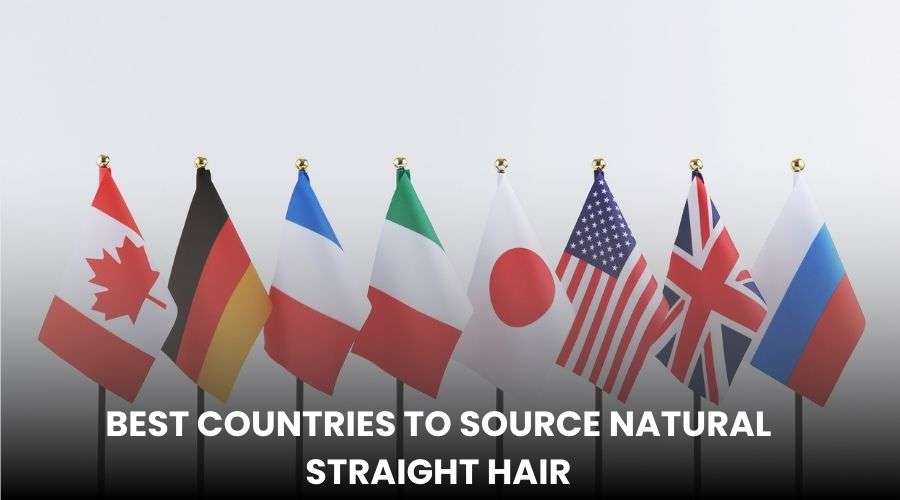
China is a dominant processing and exporting hub. You can find excellent partners there with mature logistics, strong sorting capacity, and fast turnaround. Moreover, you can find mixed-origin lots sold under whatever label the market rewards that month.
If you source from China, treat “ country of export” as a logistics fact, not an origin claim. Your success depends on how well the supplier separates lots, documents inputs, and discloses processing. Some do. Many don’t.
India is associated with high volume and broad supply. Hair marketed as “ straight” from India can range from very straight to slight wave, depending on the region and donor profile. Consequently, your sampling discipline must be tight if your brand promises a consistent, straight look.
India can work well when you sell a “ natural straight to light body wave” range, or when you have strong sorting specifications and a supplier who honors them. Nevertheless, do not assume uniformity across lots just because the grade name stayed the same.
Vietnam is frequently marketed as premium and consistent, especially for straight textures. Sometimes that holds. Sometimes the “ Vietnam hair” label is a blend of origins processed to a Vietnam spec and exported through Vietnam channels. Additionally, the premium pricing attracts premium storytelling, so verification matters.
These markets are often discussed as sources for natural straight hair or straight-leaning hair, generally with smaller volume compared to major hubs. Quality can be strong in pockets; traceability can be weak in others. Consequently, these are better treated as select suppliers rather than broad “ country strategies.”
“ Mongolian hair” is one of the most premium labels in the straight-hair category. The issue is not that great; straight hair cannot come from Central Asia; it can. The issue is that the label is widely used as a marketing shorthand. Furthermore, the tighter the supply, the more incentives exist to stretch the claim.
European-origin claims often command high prices, especially for finer fibers and certain color profiles. Availability is limited relative to global demand, and consequently, mislabeling risk is significant. If you go after European claims, your sourcing must be built on proof, not persuasion.
Most sourcing mistakes follow the same pattern: unclear origin, undisclosed processing, and inconsistent sorting. It feels sudden, but it’s not.
High-risk indicators include lots that are “ too perfect” at low prices, unusually uniform color and shine across many bundles, and a supplier who cannot explain collection and sorting in plain language. Moreover, the more times the story changes across sales reps, invoices, and packing lists, the more you should slow down.
Additionally, compliance realities shift. Trade restrictions, sanctions, and compliance expectations can tighten quickly. If you cannot prove the authenticity of the quality, then you need to be ready for fines. Consequently, your best country is the one where you can document what you are buying.
If the price feels like a win, ask what was removed. Often, it is traceability. Sometimes it is cuticle alignment. Frequently, it is long-term wear performance.
Raw and truly low-processed natural straight hair costs more because it requires better collection and careful sorting, and it cannot be manufactured into uniformity without changing the fiber. Furthermore, long lengths amplify scarcity and cost. So does insisting on narrow texture tolerance.
Build a shortlist that reflects your product strategy. If you prioritize consistent, straight-wearing performance with reliable export and strong processing capability, you may anchor relationships in major hubs while demanding higher traceability. If you prioritize strict origin claims, you will likely accept higher costs, longer timelines, and smaller volumes, and you will need backup channels.
Finally, treat sourcing as a portfolio, not a romance. Two primary channels and one backup channel reduce supply shocks and reduce the temptation to accept bad lots when demand spikes. Consequently, “ best countries” becomes a disciplined system, not a rotating list of trends.
In the market, “ straight” is used carelessly. You need precise internal definitions before you talk to s
READ FULLIf you are looking for a wholesale supply of natural straight hair, this guide is for you. Lots of salons and retaile
READ FULLHair extension businesses face critical decisions when choosing the products to offer clients. The three popular weft
READ FULL